
What Makes Us Irreplaceable?
By Janya Phlaphongphanich
1. You're 17 and building a business around a technology that is transforming the world you're growing up in. When did AI stop feeling futuristic and start feeling personal to you?
One of my first businesses was Brown Girls’ Brush, a graphic design service that I launched when I was 13. I was so passionate about using Canva and Procreate, spending hours creating the perfect birthday invites, flyers, and more for my clients. AI disrupted that pretty quickly, as most people turned to ChatGPT for graphic generation, which was quite a disappointment, but also very eye-opening. It showed me how quickly things could change: what if I built a career on something that was disrupted overnight? It was no longer something that could happen; it was already happening!
2. When you look at your generation, what do you think young people are quietly outsourcing to AI without realizing it?
A lot of people use AI for mundane tasks, and along with it they hand over the thinking and the process that used to come attached to that work. The biggest thing we're outsourcing is creativity itself, specifically that moment of frustration right before a breakthrough. That’s where I think growth actually happens, when we push through the barrier of frustration and actually learn something. The second a task gets hard, it's so easy to turn to AI and let it solve the problem for you or write it for you, but it's that challenge where learning happens that we're giving away without realizing it.
3. LivLit is built around the question, "What makes us irreplaceable?" What was happening in your own life when that question became important to you?
On the first day back at school after a summer away at Stanford, I was sitting in our Year 12 assembly. A slide on the impact of AI on the job market had the whole room buzzing with tension. The reality of certain jobs no longer existing, or being “replaced” by AI, felt very real; the uncertainty with which the discussions were framed felt like a stark contrast to the excitement with which AI was discussed at Stanford. I realized that my peers and I are entering an era of rapid change and uncertainty—the jobs and industries we are being educated and prepared for may no longer exist by the time we enter the workforce. I believe that while we can’t control what happens to us, we can choose to navigate how we respond to it. I built LivLit with this premise: I could either let this narrative built on uncertainty and anxiety shape my generation's relationship with our future, or I could contribute to rewriting the narrative to make it work for us.
4. You encountered the Irreplaceable Institute during your time at Stanford. What idea from that experience stayed with you, and how did you turn it into something that felt relevant to young people in your own community?
The Irreplaceable Institute is built for college students trying to break into a brutal job market, and the thing they emphasized most was the importance of building relationships with people who genuinely want to see you win. That reframed how I think about relationships entirely—as something you can engineer and build a skill for. Ultimately, who wants to see you succeed comes down to who you are as a person, not just who you know. That's the core lesson of the course: your skills can be taught, but who you are can't be, and that's what actually matters most. I wanted my peers to hear that years before college, while they still have time to build those relationships on purpose, and engineer the person they want to become.
5. When did LivLit shift from being an idea you were exploring personally into something you felt you needed to build?
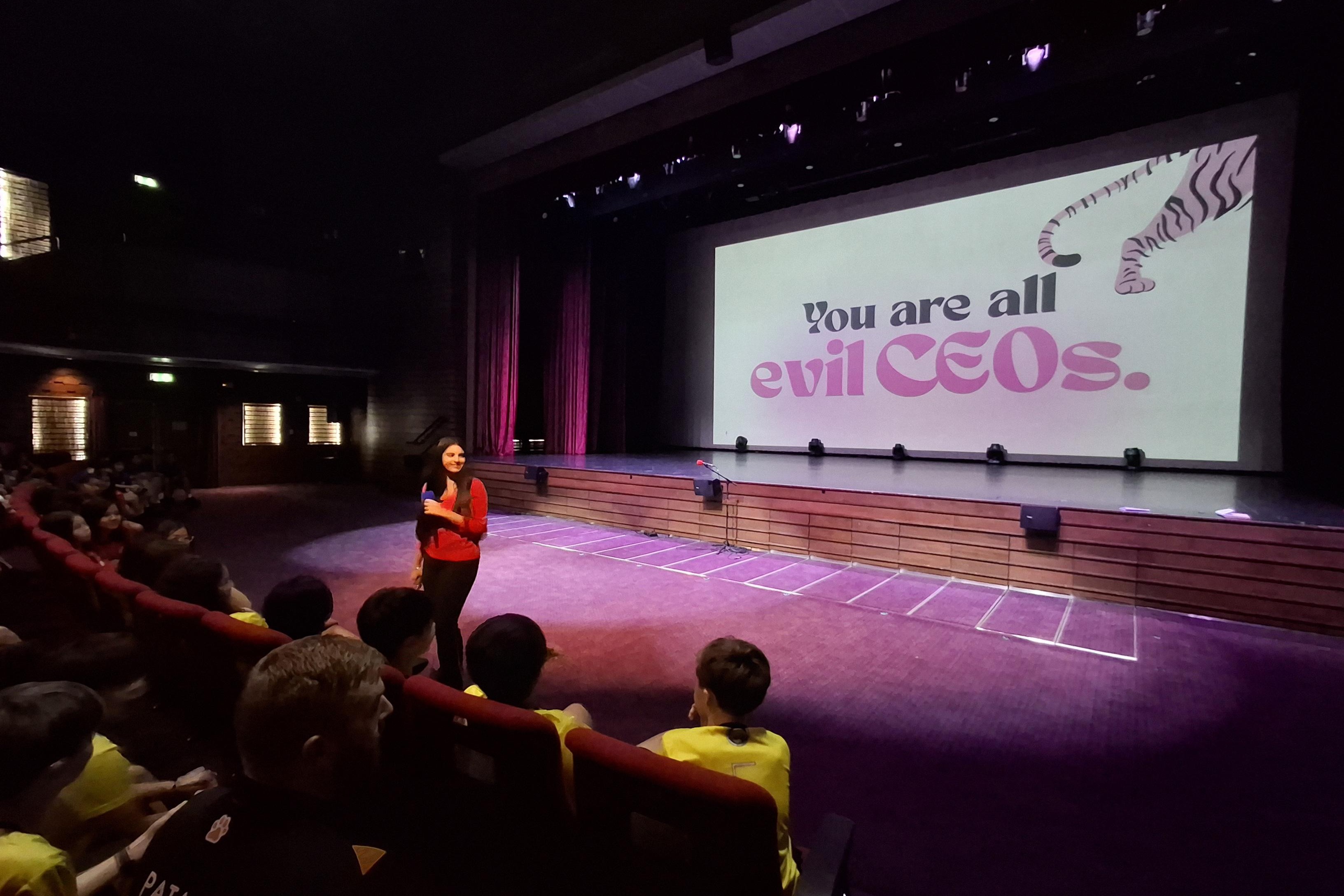
During the summer program at Stanford, I took a class called Redefining Creativity in an AI World by Prof. Rebeca Hwang and Noah Berkson, who has since become my mentor. I felt that the ideas, concepts and frameworks that I learnt from there were valuable enough to share with the wider community—my peers and other young adults entering this new world at such a critical time. At first I wasn’t sure how to go about it, but when I realized that everyone was plugged into the “AI-induced anxiety,” it was clear that there was an opportunity for me to share how I was implementing what I was learning to reshape my mindset around AI and the uncertainty surrounding it. After all, conversations can become movements, ultimately shifting mindsets and transforming the way we navigate our world. My intention was simply to use social media as a platform to share my thoughts, but that organically grew into requests from schools to come and speak to students, which then expanded into workshops.
6. Why was it important to you that this conversation about AI and being human came from a young person speaking to their peers?
I think it is important to hear LivLit’s message from a peer as I want it to be understood as a revelation someone their age has had, not an outsider’s perspective on what our generation should focus on. This is especially important as I know from first-hand experience that people tend to listen more carefully when someone their own age is talking. On top of that, I wanted to create an intimate community where people feel comfortable sharing their worries, learning about how to stay human, and growing beyond limiting beliefs—and that can only happen if they resonate with me first.
7. With AI increasingly able to write, research, design and create, what do you think young people should be investing in now to prepare for the future?
The number one thing we should all protect is our curiosity—it’s what drives our thinking, creativity, emotion, and connection. We all have a natural propensity for it: as children, we always ask: “Why?” “How?” Then at school we learn that the value is in being able to give the right answer, not asking questions. Well, now it's clear that we are going to have to unlearn this focus on right answers, and relearn the ability to ask critical questions. Young people should invest more in being human, developing strong interpersonal skills to build meaningful connections, and staying creative!
8. If you could change one thing about the way your generation thinks about AI, what would it be, and what do you hope LivLit can contribute to that change?
I'd want us to feel empowered instead of uncertain. There's so much fear wrapped around AI right now, and I understand where it comes from, but fear isn't the only honest response to this moment. There's real excitement available too, about the possibilities AI opens up and about what it can help unlock within us as people. For example, if we only think about how many jobs AI will replace, we will never be able to think about how many jobs it will create. That's what I hope LivLit contributes to: a shift from feeling like AI is happening to us, toward feeling like we get to decide what we do with it.
9. Any advice for parents who are still on the path to learning about the pros and cons of AI for themselves and their children?
At the end of the day, I believe that the fundamentals of a child’s upbringing should remain as focused on human connection, curiosity, and emotion as possible. If those things are solid, figuring out everything else about this shift gets a lot easier. It’s important to remember that in a world focused on optimisation, output and results, we are still humans—fueled by love, connection, and trust.
AI is a great amplifier, but before we can amplify, we have to become something worth amplifying.
10. You began experimenting with entrepreneurship at a very young age. How has your understanding of what it means to be a founder changed as you've grown from 10 to 17, and what advice would you give an aspiring young entrepreneur like yourself?
At 10, I was doing this as a hobby. At 17, I'm doing it because I’ve witnessed a problem I want to solve. My perspective of a founder has changed drastically; when I was younger, I loved the idea of owning my own business but never took complete responsibility for it, but now I have stepped into the role of a founder with much more maturity and passion.
For aspiring entrepreneurs: It’s easy to overthink the end goal, worry about being “good enough”, and so on, but you learn quickly that this is just internal noise. You’re never going to feel 100 per cent ready. Just start somewhere! And be kind to yourself along the way: you're still learning and figuring everything out. It’s good to make mistakes, and it's okay to ask for help along the way.
About the Author:
Janya Phlaphongphanich, 17, is the founder of LivLit and a student at Bangkok Patana School. Through workshops reaching 500+ students internationally, she's teaching the generation growing up alongside AI how to think critically about it and stay human in this technology driven world.